
Commemorating Papua New Guinea’s 50th Anniversary of Independence
To commemorate Papua New Guinea’s historic milestone 50th Anniversary of Independence on September 16, 2025, selected museums and cultural institutions were invited to come together for WanBel: a PNG Collective Global Exhibition.
The Mariwai Project, in partnership with the PNG Ministry of Tourism, Arts and Culture and its agencies the National Museum and Art Gallery, Port Moresby and the PNG National Cultural Commission (NCC), engages these collaborations as part of PNG’s official 2025 national program: Celebrate our History, Inspire our Future running through to September 16, 2026.
Over the anniversary year nearly 50 participating museums and cultural institutions are holding tailored exhibitions, educational events and workshops in their own spaces and sharing their digital learning resources, focusing on their collections which contain many significant artworks from PNG. From historical colonial collections, through to contemporary art, these collections represent an enormous wealth of PNG cultural resources and documentation. The public will benefit from expanded access to rare objects, talks, creative labs, family days, and more, creating the largest and most inclusive global exhibition of PNG art ever assembled for millions of visitors worldwide. PNG’s exceptional arts, traditions, and cultural artifacts reflect our diverse heritage. As we mark half a century of independence, we illuminate PNG’s cultural legacy and honour the artists and the cultures from which they originate.
The title for the exhibition is WanBel, a PNG Tok Pisin phrase for community spirit, literally “one belly.”
Currently exposed at the Barbier-Mueller Museum
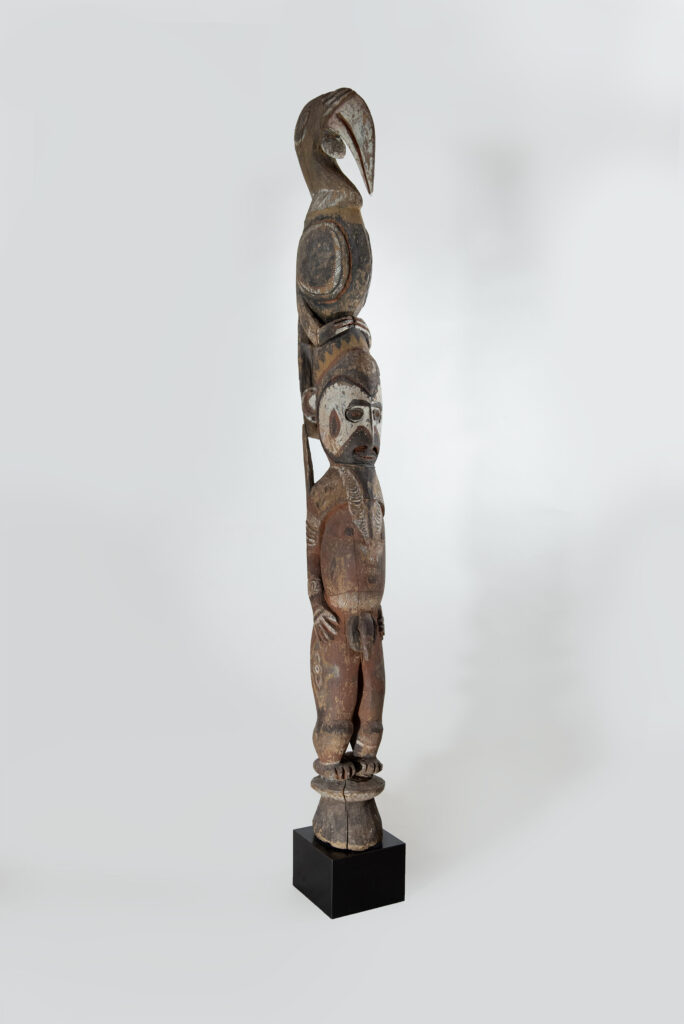
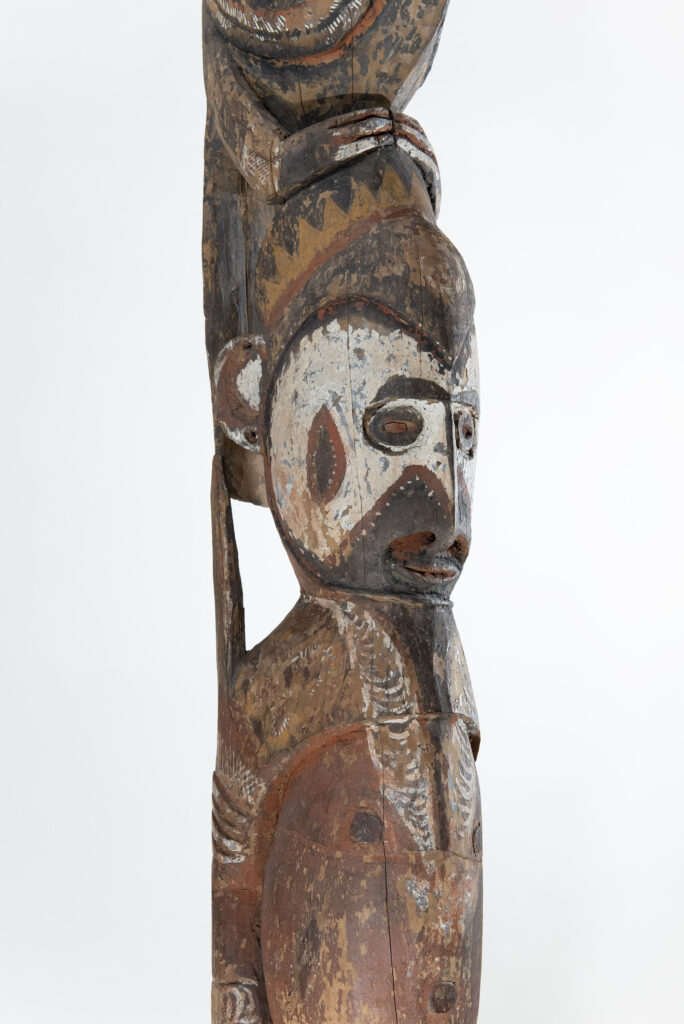
Male anthropologic figure, Maprik district, Wosera group, Papua New Guinea, 2nd half of the 19th century, polychrome wood, 123 x 12.5 x 19 cm
This carving, made out of a single piece of wood, represents an anthropomorphic male figure, with a hornbill perched on his head.
The figure is standing straight, shoulders pushed backwards, and naked apart from an indication of ornaments, either painted or carved. The legs are massive, straight, with strongly prominent knees. The feet are resting on a small platform, with the toes indicated by way of incisions. The arms, where ring ornaments have been carved out, are arched backward, with the hands resting at the junction between the thigh and the hips. The shoulders are delineated in relief, unifying the arms and upper torso, and forming an almost detached “horseshoe” shape on the back. The head, with almost no neck, has painted facial ornaments and is slightly elongated.
It also has a headdress in a slight relief. The perched hornbill is easily recognisable due to the specific shape of his beak and the indication of the wrinkles on the top of the bill. Ornaments, such as a shell necklace and shell armband are indicated either by way of painting or carving. Three-dimensional carvings representing anthropomorphic figures were common in the Maprik area.
Wapinyan, as they are called (“sons [nyaan] of the long yams [waapi]”, be they male or female) are figurations of the clan’s totemic spirit nGwaal. Made to be presented inside the ceremonial house to be seen by the initiates, they were not the spirits themselves, but one of their temporary material manifestations.
The colourful designs, as well as the indication of face paintings and body ornaments, notably the Tridacna shell rings, increased the relationship between these figures and the actual dress that these initiates would themselves wear at the end of the period of seclusion, in turn transforming them into another manifestation of these invisible procreative powers. As often the case with material representations of spirits in Melanesia, once used during these ceremonial events, images often lost their value and could become available to Western collectors. The association of anthropomorphic figures with a bird (or two birds) on the top of its head is quite a common feature throughout the area. The representation of a hornbill on the top of the head, although seemingly referring to a possible clan’s totemic bird (jaambu), seems more general.
Hornbills (paal) play an important part in announcing the incoming harvest of the yams. Associated with the sun, they also were a model for the flat carved figures presented on the front of the ceremonial house.
Ludovic Coupaye, in Shadows of New Guinea, p. 401
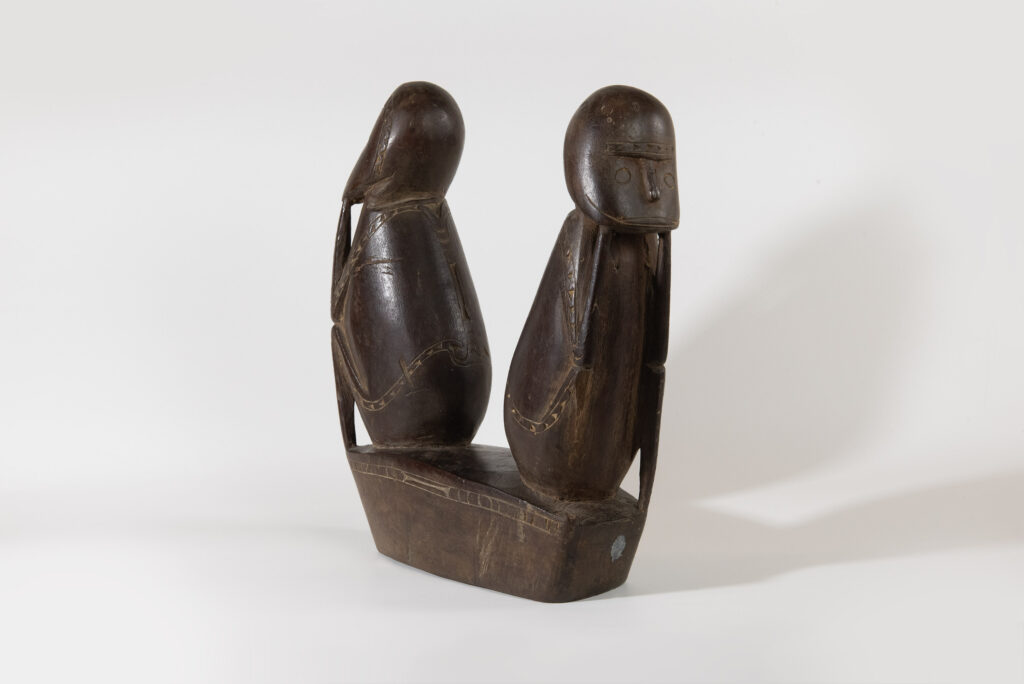
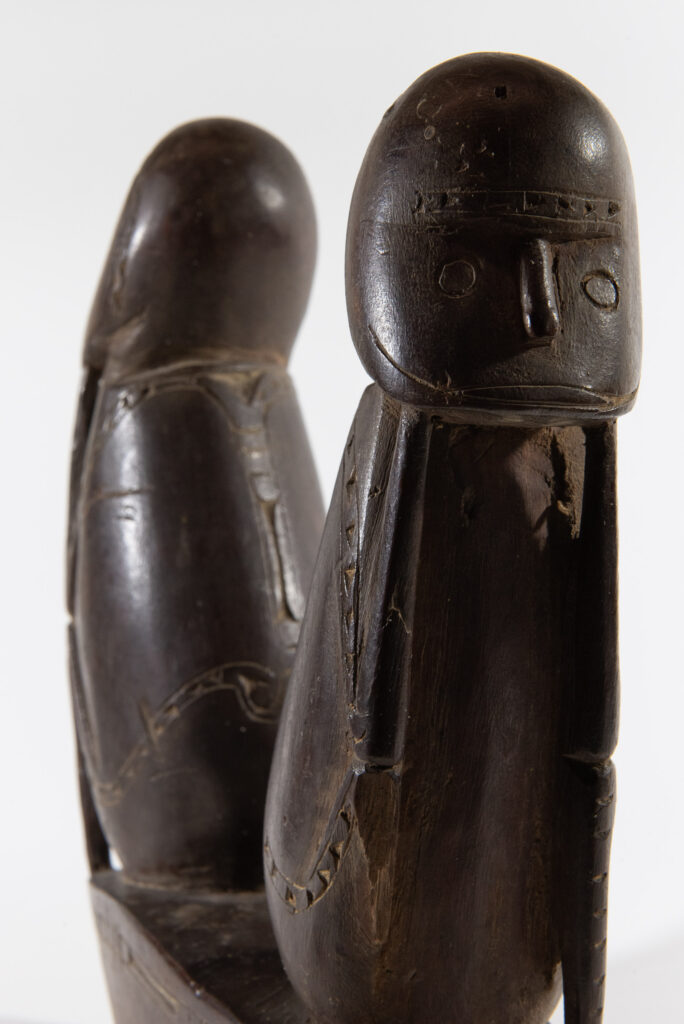
Statue of twins, Massim area, Trobriand Islands, Papua New Guinea, wood, 25.5 x 24 x 6.5 cm
This wooden sculpture depicts two figures seated back to back on a single base. It is from the Trobriand Islands, located in the Massim area, which encompasses Milne Bay in the south-east of Papua New Guinea and the surrounding islands.
The piece is notable for the engraved curvilinear motifs adorning both the base and the figures, characteristic of the decorative style of the region. The squatting posture of the figures, elbows resting on knees, is also a typical stylistic feature of Massim art, as is the emphasis on symmetry, a recurring element in the artistic production of the cultural area. The depiction of two figures may symbolise duality, a recurrent theme in Melanesian mythology.
The function of this object remains unknown. While its form is reminiscent of a pestle used to crush taro (a root vegetable) or a miniature waga (canoe hull), the presence of anthropomorphic figures rules out such uses, according to information provided by Dr linus digim’Rina.
Keilen Euzet
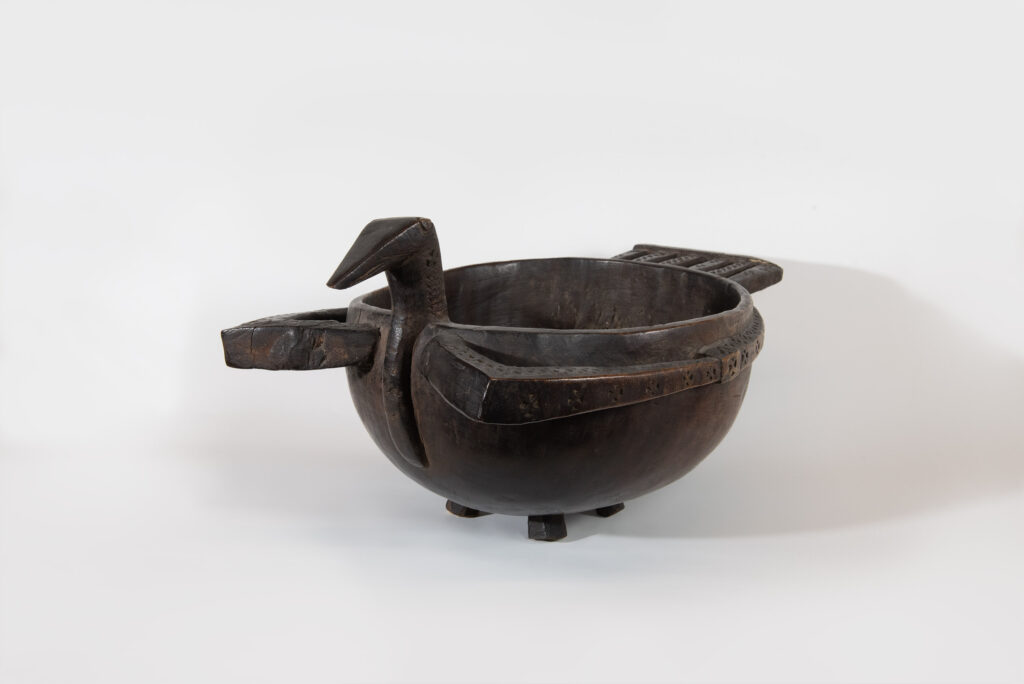
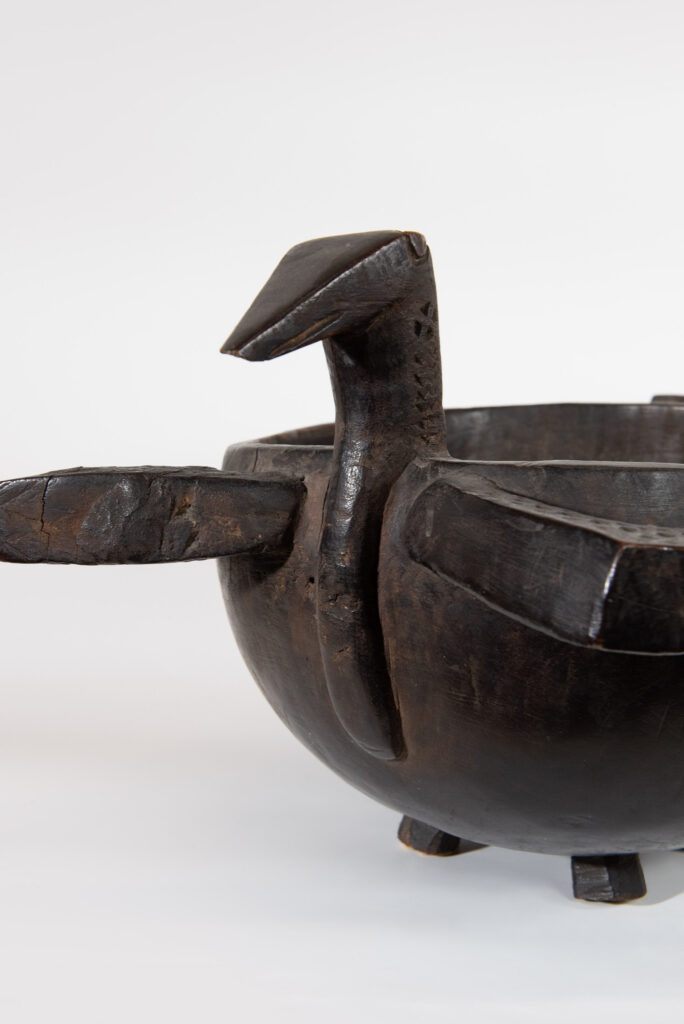
Bird-shaped bowl, Baluan Island, Admiralty Islands, Papua New Guinea, wood, length 47.5 cm
This bowl is from Baluan, a small island of around fifteen square kilometres at the southern edge of the Admiralty Islands in the Bismarck Sea.
By adapting to their fragmented environment, the peoples of the archipelago have developed an interconnected trading structure. According to the resources at its disposal, each community sends its production to this economic system. Baluan Island artisans make ladles, spatulas and bird-shaped containers. Playing a central role in the trading partnerships between communities, bird-shaped cups can hold monetary value in transactions. Ceremonial exchanges, payments and gifts take place during ritual and matrimonial events, which serve to strengthen cohesion and maintain social structures.
Bird-shaped wooden bowls are used on a daily basis to hold food preparations, particularly those made with starch extracted from the sago palm, a local tree that forms an essential part of the diet in the Admiralty Islands.
Marc-Thomas Gérard